

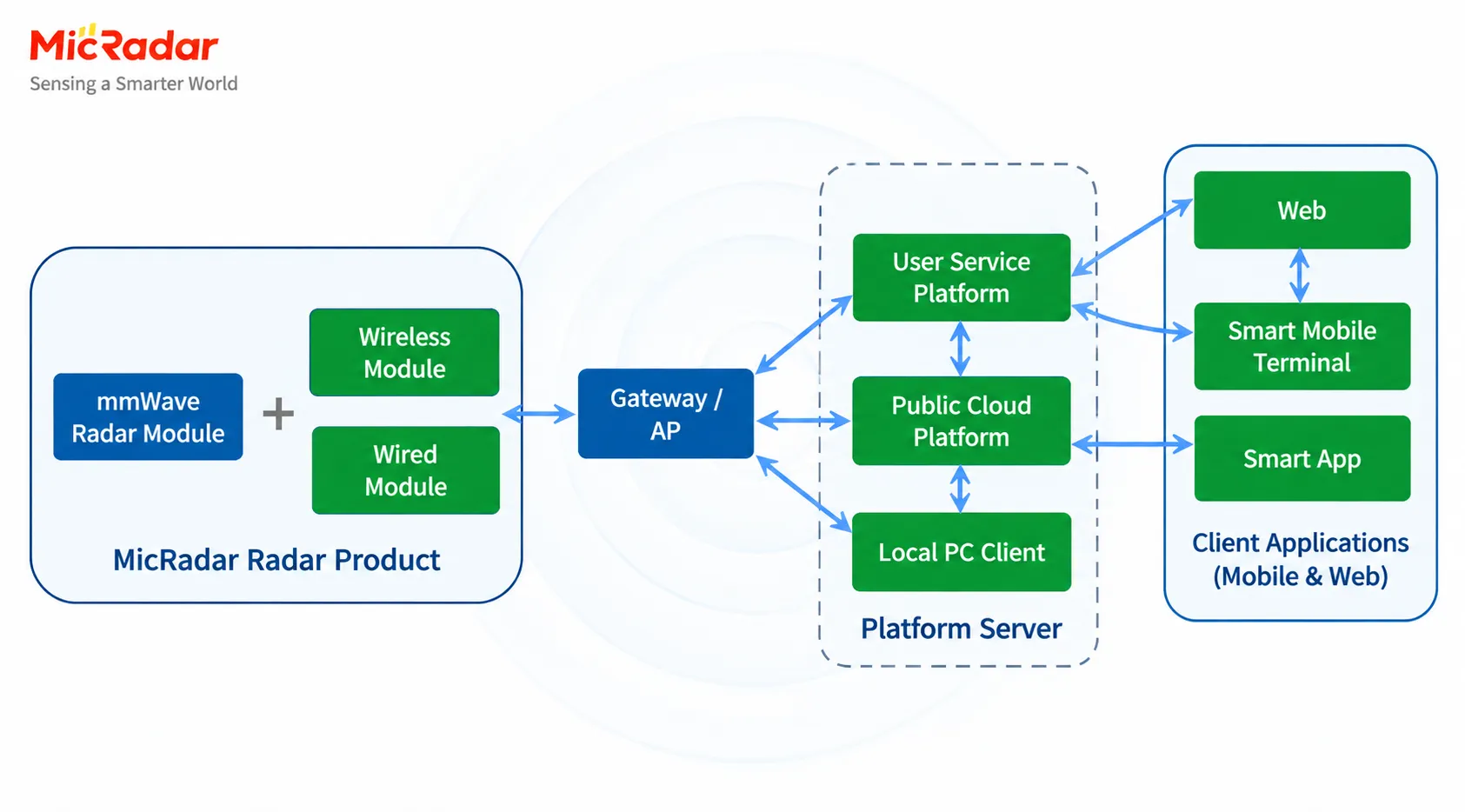
No, we don't have any software for end user. For now, we only have hoster PC software for our client interal testing. Micradar focuses on hardware only.
Radar detects the human body by transmitting and receiving electromagnetic waves. Detection accuracy may vary depending on the target's position, the installation angle, surrounding obstacles, and radar sensitivity.
1) The person is outside the effective detection range
Please refer to the radar's recommended detection range and adjust the installation position or angle accordingly. The effective detection area may vary slightly depending on the installation environment and the reflection of electromagnetic waves.
2) Metal or other obstacles block the radar signal
Thick office chairs, metal seats, or other obstacles may block or weaken the electromagnetic waves, which can affect detection accuracy.
3) The scanning angle does not cover the human body adequately
If the radar does not properly scan the person's torso or main body area, the target may not be detected correctly.
4) Radar sensitivity is too low
The radar provides adjustable sensitivity parameters. Increasing the sensitivity may help improve detection performance in certain environments.
Automotive radar is primarily designed to measure the relative position and movement of surrounding objects while the vehicle itself is moving. Its design and algorithms are optimized for dynamic driving environments.
Home-use radar is typically installed in a fixed position and is designed to detect relatively subtle human movements, such as presence, body movement, respiration, and other physiological signals. Therefore, the hardware design, signal processing, and algorithm architecture of home-use radar are significantly different from those of automotive radar.
Radar detects subtle changes in the electromagnetic waves reflected from the human body. Large body movements, chest micro-movements caused by breathing, and subtle movements associated with heartbeat produce different signal changes that can be captured and analyzed by the radar.
By processing these signal changes, the radar can determine human presence and activity status and estimate physiological parameters such as respiration and heart rate. Depending on the product and application, the radar can also provide information related to sleep status and body position.


